FYK concept car developed by Aetek, a Norwegian automaker, which collaborated and sponsored by the lubricants company, Statoil. Thisconceptcarprojectwas ledbyArildTjomsland, whichhas alotof experiencein buildinga carlikethis.
FYK car designed as an environmentally friendly vehicles by utilizing natural gas and hydrogen as the energy source. Statoil provide the fuel for FYK concept car.
Aetek FYK is environmentally friendly supercar of Norway. (Picture from: http://www.vg.no/)
The fuel used was a mixture of natural gas and hydrogen are called NaturalHy (HCNG) with the composition of 8-20% hydrogen and 92-80% of natural gas is then compressed.
This fuel is considered as a first step towards the commercialization of hydrogen fuel in the future automobile market. FYK concept car built using recycled aluminum in almost all parts, including the body, chassis, engine, wheels, and even to the interior elements. The design of the exterior and interior of the FYK concept car shows the techniques of aluminum utilization.
Although environmentally friendly, but as the concept car, it is still has a shortage of doors and interior design which seems still not maximizing functional elements and still looks difficult for driver to enter and move within it.
In addition the FYK car had been launched at the same time as Statoil opens Norway's first hydrogen/NaturalHy/natural gas filling station in August 2006 in Forus, Stavanger. But unfortunately the continued development of this concept car was not heard anymore. *** [EKA | FROM VARIOUS SOURCES | DISENO-ART]
Posted by UnknownSabtu, 07 Desember 20130
komentar
In one hundred years of Chevrolet's trip is not a short time. A lot of nice cars and great made by Chevrolet since 1901. You definitely know the Camaro, Bel Air, Silverado, Suburban, Malibu, up to the Volt. They are only a handful of Chevrolet products.
In order to celebrate the 100th anniversary of which falls on 2011, Chevrolet asked their fans to choose the Chevrolet's best cars in the history or the "Best Chevy of All Time."
After the elections in four rounds, 1969 Chevrolet Camaro finally chosen as the Best Chevy of All Time. 1969 Camaro beat 1970 ChevelleSS. In the elimination round Camaro gets about 25 thousand from 124 thousand voters.
"I believe the 1969 Camaro is not only the best car in the Chevrolet historians, but also one of the best cars in the world," said Tom Peters, Chevrolet Design director. Peters himself has a 1969 Camaro for 20 years.
"I still remember when I first saw the Camaro in 1969. When I was 14 years old," he recalled. "The purpose of the Camaro instantly understood, even by a small child in my age."
According to him, the Camaro has a very powerful personality and an elegant simple design. "Camaro is very cool. Offers a very attractive design and high-performance engines," he added.
"Today the Camaro became one of the best cars. Such cars other best design, the Camaro is more than just a machine because it evokes powerful emotions of people of all ages," he said further. "That's why this car be our inspiration when designing the fifth-generation Camaro."
But for me, 1957 Chevrolet Bel Air is my favourite Chevy car. So how about you? *** [EKA | FROM VARIOUS SOURCES | AUTOEVOLUTION] Note: Thisblogcan be accessedviayoursmartphone.
Posted by UnknownKamis, 05 Desember 20130
komentar
Supercar producion is a high-level gamble for car manufacturers. When the car selling is successful, then it is definitely a big advantage will flow, at the same time will be an important legacy for the company.
Successful supercars widely known, because they got publications from various media. But what about the supercar production that failed. How many of them? Of course there were so many, but on this occasion will be discussed as much as 5 car production is overlooked. Let's see one by one,
5. Dome Zero
First introduced by Dome Co. Ltd. at the 1978 Geneva Motor Show and is intended to enliven the small sport car market. Dome Zero builds upon knowledge of the designer Minoru Hayashi. Unfortunately, the eccentric billionaire's dreams were dashed when the car failed homologation tests in Japan. The project was abandoned just like that.
The car that has 6-wheeled was built in 1977 and equipped with 8.2-liter V8 Cadillac twin turbo engine, and claimed to be able to step on the gas up to 322 kph (200.08 mph). The Panther Six is made in limited numbers, i.e. only 2 units (black & white). So far only one unit of the car seen in the Middle East when the NEC Classic Car Show 2008.
Same with Phanter Six, this car also made only 2 units and was designed by Peter Monteverdi. This car using the Chrysler Hemi V8 7.0-liter engine, and could be burst 456 PS of power and a top speed of 290 kph (180.2 mph). Initially, the car created to rival Lamborghini, Ferrari and Maserati. Apparently, the German company that introduced not produce it anymore.
Although Gigliato was a Japanese concern, its plan was to base itself in the UK and to become a serious rival to the established Italian design houses. That was back in 1994, when its rather attractive Aerosa was unveiled, powered by a Ford-sourced 3-litre V6. With a bit of tickling, a reliable 300bhp could be coaxed from this powerplant – but it was all academic, as by 1995 the project was history.
Commendatore 112i is already well-known in the video game "Need for Speed II" and was designed by Isdera, the German company in 1993. The car that has a weighs of 1,450 kg, is able to sprint from 0-100 kph in 4.7 seconds and a top speed of 343 kph (213.13 mph).
Not only that, the car also has unique features, including a gull-wing doors style, electronically controlled chassis (down at high speed) and automatic air brake. Supercar which uses Mercedes-Benz V12 6.0-liter engine, that produced 408 PS of power, but after being introduced just disappeared like a winds. *** [EKA | FROM VARIOUS SOURCES]
A Polish sports car company, Arrinera Automotive finally officially announced their new sports car, named Arrinera Hussarya. This car was deliberately designed to evoke memories of the glory of Hussar (the 16th century Polish cavalry that renowned for its agility, strength, and beauty).
Overview of the name might remind us of the Pagani Huayra or of body shape has many similarities with the Lamborghini Murcielago, Gallardo and Aventador even. The similarity is shown in the form of lines of Poland's sports car design.
Front left side view of Arrinera Hussarya with its scissor-doors opened. (Picture from:http://auto.idnes.cz/)
Nevertheless, Arrinera claimed that the car isn't plagiarized from renowned major brands. Further, that Hussarya it looks so charming, strong and aggressive with his display which is equipped with many sharp lines and stiff curves. Arrinera's design team worked through until the completion of the design phase of research in aeronautical engineering laboratory of the Warsaw University of Technology for 14 months.
As quoted from Carscoops on November 27, 2013, that since the beginning of the development of the sports car, Arrinera get help from Lee Noble, the founder of Noble Automotive and one of the key men behind the Ultima GTRrecord-breaking. It is a well known fact that the cars were produced by Noble renowned with excellent handling, and this must be reflected in Hussarya, when the super car ready to sold.
In addition to the car exterior that has an aggressive looks with stripes details, Arrinera Automotive has also completed the Hussarya with a high-strength steel made chassis. While on suspension, Arrinera implement a multi-link system that has been designed in such a way that the Polish sports car control becomes more easier.
Super cars that use automatic spoiler, because its focus on aerodynamics, the front vent made twins. The specialty of the automatic spoiler, where the features works based on the speed of the car. When the driver took off the gas and brake pedal, the spoiler would be slightly raised to add the wind resistance force.
The interior is also luxurious made. However, on the driver's side is more "clean" . There is only the ignition key with remote position next to the steering wheel and a few buttons that do not interfere with the driver's view. Thus expected the driver to be more concentrated while drove on high-speed.
While on the machine, Hussarya had prepared a great power of the supercharged V8 with capacity of 6.2 liter engine that capable of producing power up to 650 PS (478 kW / 641 hp) with 820 Nm (605 lb-ft) of highest torque. This machine is connected to the Graziano transmission system that is capable to carrying 1,300 kg (2,866 lbs) sports car accelerates from 0 to 100 kph (62 mph) in just 3.2 seconds with a top speed of 340 kph (211.27 mph). This machine is also similar to LS9 coded engine that used by the Chevrolet Corvette ZR1.
Arrinera Hussarya now have finished taking the performance test stage. The plan, the prototype will be taken to Spain to toughness test. If all goes according to plan, Arrinera hopes Hussarya can be sold at the end of 2013. A limited launch edition model, the 33 Series, will be released beforehand with only 33 units being built. The 33 Series supercars will be distinguished by special equipment and some finer carbon fiber detailing. *** [EKA | FROM VARIOUA SOURCES | ARRINERA AUTOMOTIVE | AUTOEVOLUTION]
Posted by UnknownSenin, 02 Desember 20130
komentar
Maybe some of us still remember Tucuxi, the Indonesian electric cars. In January 2013 the car had an accident when crossing the eastern slope of Mount Lawu, Magetan, East Java (jump to related article). Now Indonesia launched a new electric sports car, with carries the name "Selo" (Javanese, means stone), this car Manufacturing process is somewhat special, because this car is made from scratch, not a modified version of an existing car. The total cost spent around Rp. 1.5 billion.
When a national electric car trial in Bandung City Hall, on Tuesday, November 26, 2013 ago, Selo became the center of attention. Imagine, the electric sports car of 'Kupu-Kupu Malam,' a Yogyakarta modification workshop has a bright yellow body. Not to mention the visual appeal of the other, as both doors are designed with scissors style like a sports car in general.
Front-left side view of Selo Electric Sportscar. (Picture from: http://m.otosia.com/)
According to Yoga Tatar Nugroho, a Supervising Technician at the Kupu-Kupu Malam said, that since March, 2013 that the manufacture idea of an electric car was come. When it is, Dahlan Iskan ordered the car, one of which is designed like a sports car. "In general, it follow the standard of manufacture of existing sports car, then maybe someone said that Selo car looks like certain brands," he said.
At first glance, do not be surprised if someone expected Selo is the Lamborghini. But apparently, there is no part of Lamborghini that is attached to the Selo body. Tatar said, in the early stages where the chassis frame made by hand, not take away from the framework of other existing cars. Then the aerodynamic body was designed and built with a carbon fiber materials.
Electric engine that drives the car is fitted at the rear. This machine is capable of producing power of 130 kW that can drive this car with a power of 150 hp. Power from the engine is channeled to the rear wheels through a four speed automatic transmission system. As the car's mover, power derived from a battery with a total power of 650 volts. "Theres's one battery produces about 3.2 volts. So in one car, there are more than 100 units of the battery, stored in the back and the front," said Tatar. Until now, the car battery can last about 6 hours. Recharging the battery from empty to full, takes about 4 hours.
For the interior, there are four seats arranged in two rows. As for road safety, there are two airbags, that is on steering wheel and the left dashboard. Seeing the inside of the car, Selo is carrying the Sport Car concept that has standard features such as air conditioning, Sony LCD, PanelView C600 (Allen-Bradley), hazard button, Cruise Control, as well as the turn signal. Form of indicator screen pointer speed, mileage, fuel and so on, using a digital display and window glass and mirrors driven electrically.
To enhance the external appearance of Selo, its two-door designed with scissors style. The door opened towards the top, so it looks like the wings when viewed from the front. Then the side air-scoop made of carbon fiber is also taped to the side to cool the engine and brakes.
"It's not all self-made parts, there's a purchase components, such as brakes or wheel components. From all parts of the car, we made about 70%," says Tatar. Once it is completed made, the car was first tested in Jakarta. Then when the APEC summit in Bali early October 2013, Selo is re-tested with a number of other electric cars. And by the end of this year, Selo will toured to 5 cities in Indonesia together with the other electric cars.
In terms of speed, the rear wheel drive car is believed to be capable of driving above 120 kph. But the test can not be done to get that far. One of the problems encountered is the legality constraints. This car has not had a complete of vehicle administration letters. Thus, it can not be taken arbitrarily speeding down the street.
There is a possibility, the Selo emergence responded pessimistic. National car discourse has been repeatedly heralded. But until now, there has been no national production car capable of mass production and decent down to the street. Perhaps the issue is not as simple as one might imagine. But it could not hurt to cultivate hope. Tomorrow, the day after tomorrow, or at some point, people will be proud of the Indonesian cars. *** [EKA | FROM VARIOUS SOURCES | J PAMBUDI | PIKIRAN RAKYAT 29112013]
Posted by UnknownMinggu, 01 Desember 20130
komentar
Car enthusiasts will surely want to take a look at the newest supercar on the scene – the HTT Pléthore LC-750. It is made by Canada-based HTT Technologies and is the result of six years of development headed by company principle Luc Chartrand.
It had been made its world debut at the 2009 Frankfurt Motor Show. If you recall, a previous version had been shown at the 2007 Montreal Auto Show, back when it had the Locus Plethore nameplate.
This production Pléthore features a McLaren F1 style center driving position and a very wide wheelbase even in supercar standards. The chassis and body are made of carbon fiber, while the suspension is electronically adjustable.
Comprised of a carbon fiber architecture and body with an integrated (and supposedly soon-to-be) FIA-certified roll-cage, the Plethora could be the first production vehicle simultaneously approved for both the road and the track, and since high-level competition is close to Chartrand's heart, it's a necessity -- he wants to see the Plethore competing in the American LeMans series.
To hang with the big boys at the upper echelons of motorsport, the Pléthore has to be more than a lightweight body (2,535 pounds) and a massive stance (89 inches in the rear). So Chartrand has mounted the Corvette ZR1's LS9 longitudinally amidships and tweaked output to 750 hp. As with all start-ups, HTT plans to offer an even hotter version to the public, putting out a claimed 1,300 hp with the help of a set of turbos.
Currently channeling all that grunt to the ground is a six-speed manual, but there are plans to offer a six-speed sequential gearbox along with a limited-slip differential. Double wishbones are fitted at all four corners to keep the 19-inch (front) and 20-inch (rear) wheels in constant contact with the ground, with AP Racing brakes sized 15-inches in front (six-piston caliper) and 13-inches (four-piston caliper) in the rear.
Although the astronomical output and production-intensive architecture are the cornerstones of the project, the interior - with its central mounted driving position, room for two occupants (sounds familiar) and roof-mounted switchgear - are some of the more impressive details. That, and the hydraulically actuated doors, which swing upwards and close at the touch of a button.
HTT claims that the central driving position allows for a better feel of the car and increased "stability and driveability." Moreover, this allows for optional two seats to be fitted in the front, making it the world’s first three-passenger supercar. Its visual trademark is the bat-like scissor doors that open at a wider than 90-degree angle.
Just by looking at the car, you’d know that it has impressive aerodynamic parts, integrating a racy front lip and a large rear diffuser, both with the role of increasing the down force. Powering the car is a 6.2-liter V8 developed in-house by HTT, with a 750 hp output. The Pléthore LC-750 weighs 2,535 lbs (1,150 kgs). (Jump to another Canadian Supercar.) *** [EKA | FROM VARIOUS SOURCES | HTT TECHNOLOGIES | GTSPIRT.COM] Note: Thisblogcan be accessedviayoursmartphone.
Posted by UnknownSabtu, 30 November 20130
komentar
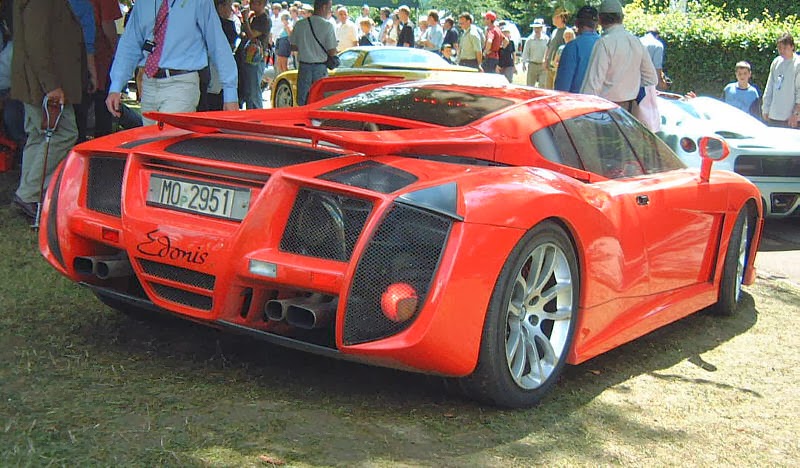
So many supercars that have been made by the world's automotive manufacturers. And the following is one of them, the car was introduced to the public since 2001. I am interested in discussing it this time, because of the quite exotic and has a powerful specs anyway.
The Edonis (Greek for ‘pleasure’) is a car created by B Engineering, an Italian small-volume automobile manufacturer. It is made up of several former employees of the Bugatti firm when it was under the leadership of Romano Artioli.
The car was launched on January 1, 2001 and is based on the Bugatti EB110 Super Sport but has been extensively re-engineered, the only thing retained from the original Bugatti is the carbon-fiber chassis. The Edonis uses the same V12 engine as found in the Bugatti EB110 but its engine displacement had increased from 3,500 cc to 3,760 cc.
The original four small IHI turbochargers have been replaced by two larger units from the same manufacturer. Engine power has been boosted from 610 hp DIN (448 kW) and 650 Nm (479 ft-lbf) of torque to 680 hp DIN (500 kW) at 8,000 rpm and 735 Nm (539 ft-lbf). The engine’s specific power output is an unprecedented 181 bhp/liter.
Both the exterior and interior of the car have been completely redesigned. The tires of the Edonis are specifically designed by Michelin. The tires use a system invented by Michelin, the called PAX System.
The 4WD triple-differential drivetrain from the original Bugatti has been replaced with a much simpler and lighter RWD transaxle, thus saving approximately 70 kg from total weight. Edonis has a total weight of 1,500 kg (3,306.93 lbs), so these power figures give to a power-to-weight ratio of 480 bhp/ton. They claimed performance figures are a top speed of 227 mph (365 kph) and acceleration to 62 mph (100 kph) in 3.9 seconds. *** [EKA | FROM VARIOUS SOURCES | TOP SPEED | SUPERCAR WORLD]

 Many ways in which the automotive industry to create environmentally friendly concept car, one of them by cooperating with other companies to develop this vehicle.
 FYK concept car developed by Aetek, a Norwegian automaker, which collaborated and sponsored by the lubricants company, Statoil. This concept car project was led by Arild Tjomsland, which has a lot of experience in building a car like this.